
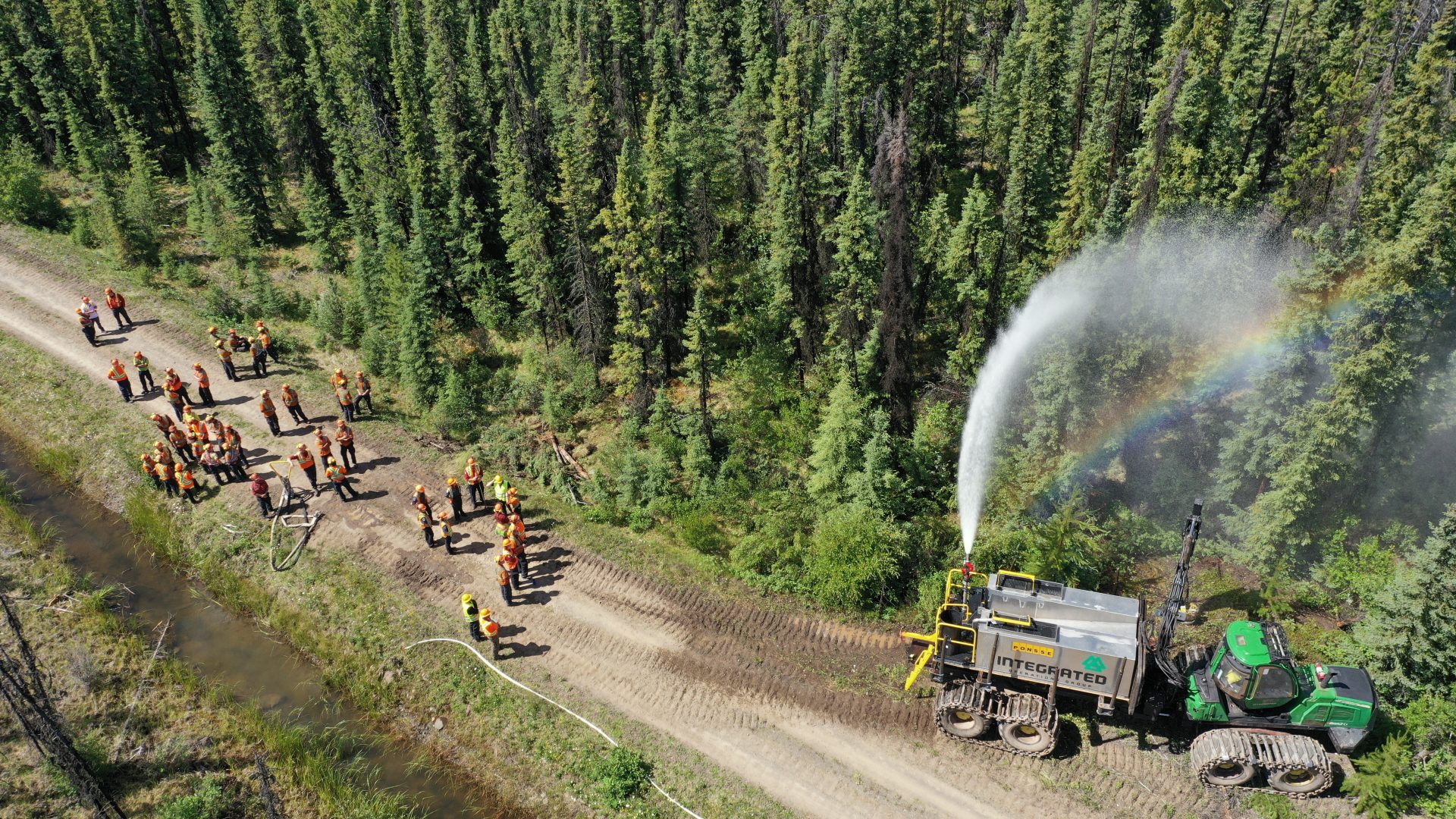
Ponsse Fire Suppression Unit brings forestry mobility to British Columbia wildfire fight
Integrated Operations Group has introduced a new tool to help battle wildfires in British Columbia.
Based in Campbell River, B.C., Integrated Operations Group (IOG) specializes in difficult, remote and specialized forest operations. One of its focuses is commercial thinning, and the company applies European-inspired harvesting equipment and methods, such as higher-retention thinning rather than clear-cutting a stand.
Integrated Operations Group has also worked in wildfire mitigation for several years. However, its fleet of Ponsse forestry equipment has also allowed IOG to enter direct wildfire suppression.
In July, the company announced it had deployed a Ponsse Fire Suppression Unit, the first machine of its kind in Canada, to an active fire in B.C.
“A couple years ago, Ponsse came up with this kind of fire suppression unit that we thought was really neat,” said Quentin Stefani, Managing Partner and Commercial Thinning Operations Manager at Integrated Operations Group. “With the megafires we’re having every year now, we thought it would be interesting to get one and put it to work.”
The Ponsse Fire Suppression Unit introduces the mobility of forestry equipment to wildfire response, allowing crews to carry and deploy large volumes of water in terrain that may be inaccessible to conventional firefighting equipment. The fire suppression unit mounts on a forwarder, which IOG uses for commercial thinning.
“We don’t usually fight fires during the summer. We’re busy enough that we just focus on our core business,” Stefani said. “But it was just like an add-on, a tool that we can have on one of our existing machines that we could basically send to the fire line to fight fire.”
10,000-litre capacity

The fire suppression system combines a 10,000-litre water tank with high-capacity pumping equipment and a remote-controlled water cannon.
A hydraulic suction pump allows the machine to refill its water tank without requiring priming. The system can draw water from relatively small or shallow sources, including creek lines and roadside ditches, which reduces the need for the unit to return to established filling stations.
“We can suck water from a ditch line, a creek or a lake or pond. It takes about seven minutes to fill up 10,000 litres,” Stefani said. “On the fire line, it’s very rare to have access to water sources nearby. So, it is nice not having to set up bladders or having helicopters, it is like a cheaper way to deliver water.”
Once on site, water can be delivered through a remote-controlled cannon with a reach of about 45 metres. The remote operation allows the operator to control water application from the machine while maintaining distance from the fire.
As well, firefighters can bypass the water cannon and hook up hoses to the tank to tackle hot spots, which is how B.C. crews have mainly utilized the system.
“We can keep three firefighters actually extinguishing fires for four hours without having the need to refill the tank — that is pretty major,” Stefani said. “So, in a 12-hour shift, you basically only need to refill the tank three times.”
New terrain

The Ponsse Fire Suppression Unit is also designed to access rugged off-road conditions, using the flotation, ground clearance and traction of a forestry machine to travel through areas where on-road firefighting equipment could not easily access.
Rather than relying exclusively on road access, the Ponsse platform can travel across uneven and soft terrain commonly encountered in logging operations and remote forest environments.
You may also like:
- Bobcat’s T86-2 CTL gets a factory-installed forestry package
- Caterpillar introduces new FM528 forestry excavator
- Waratah launches forestry grapple line
“Now, we’re running the forwarders wherever it’s needed. We can actually go in the bush over fairly steep terrain. We can deliver water wherever it’s needed,” Stefani said.
The combination of water capacity and off-road mobility creates a machine that sits between a conventional water tender and specialized forestry equipment. The unique setup created a hiccup in achieving approval from BC Wildfire Service to operate.
“Nobody had ever seen anything like this before. The hurdle wasn’t proving the concept, it was which box are we going to put this set up in,” Stefani said. “It’s got its own kind of category now.”
Early results
As of mid-August, IOG’s Ponsse Fire Suppression Unit had been sent to help fight three fires in the Caribou Region of the central interior of British Columbia. When the wildfire season ends, Integrated Operations Group will evaluate the machine’s performance and decide upon expanding the fleet of fire suppression units.
“The feedback that we received is overall very positive. The versatility of it is the main one,” Stefani said.


