
From Alberta muskeg to forestry applications around the world, Lamtrac has built its business around specialized tracked carriers
From grooming snowmobile trails to tackling demanding land-clearing applications, Lamtrac has built its business around machines designed to work where conventional equipment can struggle.
Based in Tracadie, New Brunswick, Lamtrac was founded in 1995 as a manufacturer of custom snow vehicles. However, a request from a customer in the Alberta oilfields would change the company’s direction and help establish an international brand.
Central to the early machines was Lamtrac’s quad-track articulated platform, which uses four independently mounted tracks and an articulated chassis to distribute machine weight while maintaining traction in deep snow and soft ground conditions.
Lamtrac founder Donald Gauvin was asked to use that technology to create a tractor that could run a mulcher in Alberta’s muskeg for resource exploration.
“He adapted his snow tractor to run a mulcher head, and that was how we got into that business. Now, it’s 95 per cent of our business,” said Philippe Allain, Lamtrac’s Director of Sales and Marketing.
Lamtrac began manufacturing its specialized tracked carriers for vegetation management in the early 2000s. Today, the company has become an international manufacturer providing vegetation control machines around the world.
“We have our first units that went into South America and Europe just last year. We now have a dealer in France too. So, we’re spreading all over the place,” Allain said.
Made in Canada
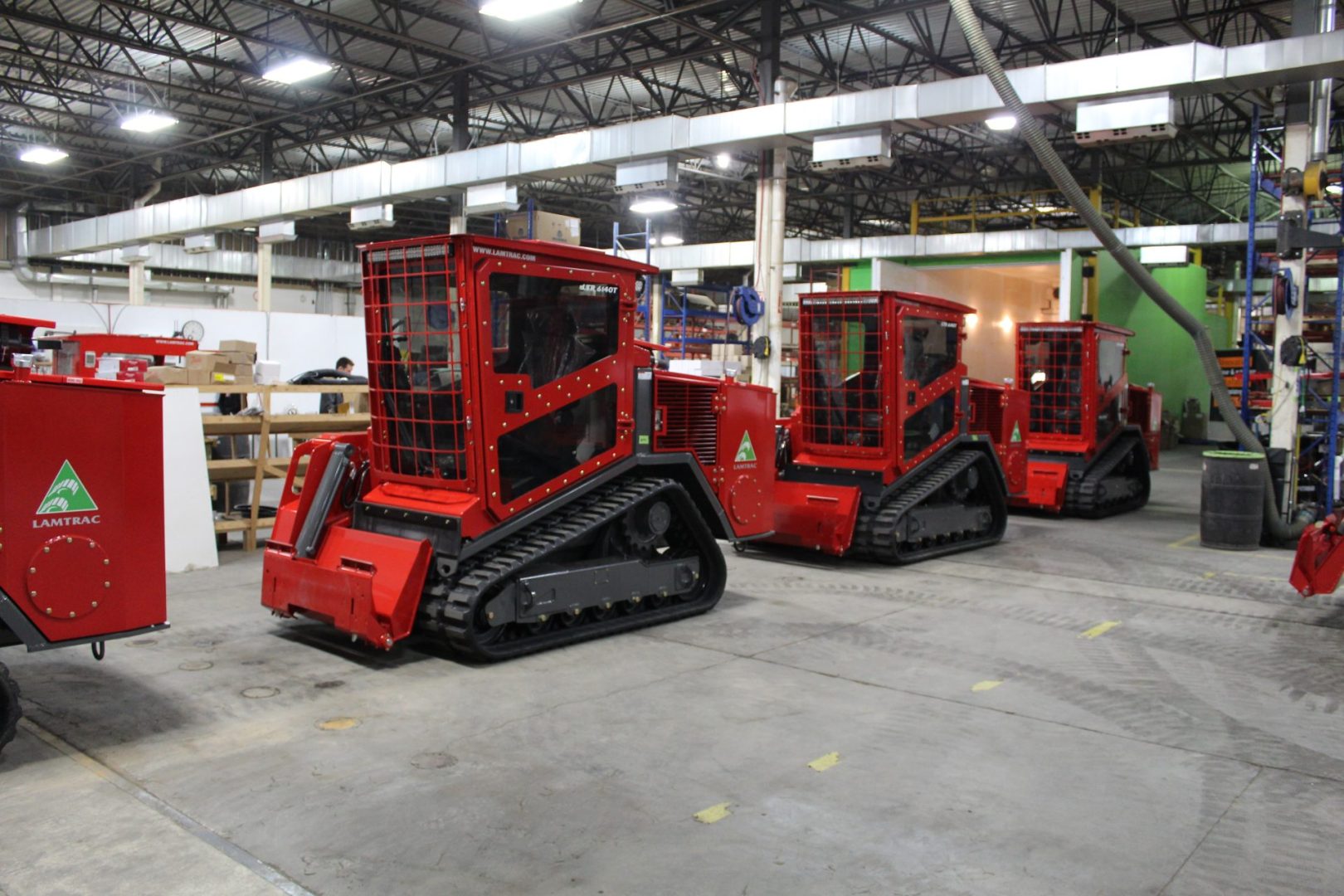
At its New Brunswick headquarters, Lamtrac operates from a 100,000-square-foot manufacturing facility, where its 60 employees carry out all engineering, product development and equipment production.
“Everything is done here in-house,” Allain said.
Lamtrac also sells equipment directly from its headquarters, as well as through its growing dealer network.
“There’s dealer opportunities as we speak across Canada,” Allain noted.
The family-owned company has developed more than 20 machine models ranging from about 125 to 600 hp, using both two-track and four-track configurations. The machines have been developed for applications including mechanical land clearing, wildfire fuel reduction, storm cleanup, resource exploration and site development.
“We see a lot more utilization in forest fire. It’s either on fuel reduction or fire line breaks. Even during fires they’ll use the equipment to clear a path to stop the fire from spreading,” Allain said.
Filling a void

Allain explained part of Lamtrac’s success is its focus on building industry-specific machines. Rather than adapting a conventional compact track loader or dozer for forestry work, Lamtrac’s approach has increasingly focused on purpose-built carriers designed around the demands of high-flow attachments and continuous mulching.
“We saw thousands of mulcher heads being sold on conventional construction skid steers. These tractors aren’t made for those mulcher heads,” he said. “We used everything we’ve learned from the big tractors, the big horsepower stuff, but made it for people that are graduating from a conventional CTL to a dedicated machine.”
For example, Lamtrac’s machines are equipped with a dedicated, 166-litre-per-minute hydraulic pump for the mulcher attachment.
“When you go up a hill or turn the tracks of the tractor, you’re not stuck. That makes it literally a dedicated vegetation management tractor, but with the look, feel and the versatility of a skid steer,” Allain said.
Lamtrac is also the only vegetation management machine with ROPS (rollover protective structure), FOPS (falling object protective structure) and OPS (operator protective structure) certification.
“That’s important if the operator or the company is working on government jobs or with unionized workers. Those requirements are very important,” Allain said. “So, that’s kind of how we differentiate ourselves from conventional skid steers.”
The 6160 Series
The company’s current forestry lineup includes the LTR 6160T and LTR 6160RST.
The rubber-track LTR 6160T is powered by a 155-hp Cummins B4.5 Stage V engine.
The machine is designed around maximizing hydraulic performance and cooling capacity while maintaining a relatively compact size.
The carrier uses a Torflex-style suspended undercarriage developed to improve stability, manoeuvrability and operator comfort compared with previous generations. Maintenance access is provided through features including a tilting cab, engine compartment access and removable belly pans.
For contractors looking for a more severe-duty undercarriage, Lamtrac developed the LTR 6160RST. The RST retains much of the mechanical and engineering architecture of the rubber-track LTR 6160T but replaces the undercarriage with a rigid-mounted steel track system intended for demanding forestry applications.
For operator comfort, both machines are equipped with a mechanically pressurized cab, which uses a filter and turbine to create positive pressure, preventing dust and debris from entering the operator’s workspace.
“It just completely reduces the infiltration of dust. From a breathing standpoint the cab is always clean,” Allain said.
For easy access, Lamtrac also equips its machines with side doors to eliminate the hurdle and safety risk of having to climb over the mulcher.
“With conventional compact track loaders, you need to get into the cab by stepping over the mulcher head that could still be turning,” Allain said. “We don’t have to do that. We can come in directly from the side of the tractor, so it’s much safer and more comfortable.”
Alongside its own machines, Lamtrac has also used its engineering and manufacturing capabilities to develop equipment for other manufacturers.
The company has worked with several global brands, while its engineering expertise has also been applied to projects outside forestry in industries including oil and gas, agriculture and commercial fisheries.
“Where most people would see the Lamtrac mulcher heads in the industry is we have a private-label agreement with the folks at Blue Diamond Attachments out of Knoxville, Tennessee,” Allain said.
While its machines have changed considerably since the company’s first trail groomers, Lamtrac continues to develop new solutions to help its customers deliver power to the ground while maintaining mobility in terrain where conventional wheeled or tracked machines may have difficulty operating.
“We’ll have some surprises with new models for 2027. We have a few tricks up our sleeve,” Allain said.