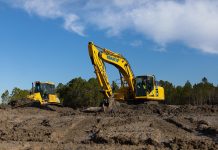

Following a large investment in AI construction technology, Gravis Robotics is now positioned to expand its autonomous heavy equipment technology to jobsites around the world.
SoftBank recently announced it is investing $200 million in Gravis, the largest Series A funding in construction robotics history.
Gravis was founded in 2022 to bring software-defined intelligence to the construction industry. Spun out of the Swiss university ETH Zurich, the company has spent the last four years building on that technical foundation to turn heavy iron into commercial robotic systems.
“To build the future, we need to change the world, literally. Whether we are building housing, modernizing energy grids or scaling data centres, every project starts with moving earth,” said Ryan Luke Johns, CEO and Co-founder of Gravis Robotics.
“That foundational work has been the bottleneck slowing down the entire built environment. Our machines are built for the messy, unscripted reality of live jobsites that breaks traditional automation. With SoftBank’s backing, we can hire the best builders and engineers, put Gravis-powered autonomy on every major jobsite and scale faster than anyone thought possible.”
How Gravis works

Acting as an operating system for mixed fleets, the company’s software runs on the Gravis Rack, an autonomous control kit, which has been installed across a wide range of heavy equipment brands including Caterpillar, Case, Develon, John Deere, JCB, Hitachi, Sumitomo, Yanmar and Volvo.
The Gravis learning-based models can adapt to the nuances of machines, allowing the same core software to operate a compact excavator or a machine five times its size without custom reprogramming.
This understanding individual machines and how they interact with the ground has allowed Gravis to boost productivity by up to 30 per cent compared to peak manual operation, while simultaneously improving overall worksite safety, according to the company.
The Gravis software stack is built for flexibility, offering a full operational spectrum between AI-augmented manual control and full autonomy.
With Gravis Copilot, operators stay in the cab, utilizing real-time 3D guidance and hazard detection to elevate their daily performance.
When full autonomy is engaged, those same operators can step away into safe environments to supervise entire robotic fleets at once. Regardless of the mode, every Gravis-equipped machine acts as a continuous site sensor — automating surveying and hazard mapping in the background as the work gets done.
Earlier this year at ConExpo, Gravis demonstrated its systems’ earthmoving capabilities in collaboration with Develon and Hitachi.
“Skilled operators read the earth through subtle physical feedback — listening to the engine strain, sensing the machine vibration and reacting to hydraulic resistance,” said Dominic Jud, CTO and Co-founder of Gravis Robotics.
“Our AI takes that same physical input and grounds it in machine telemetry, responding to varying subterranean forces and soil mechanics at microsecond speeds. We didn’t try to simplify the world for our software; we gave it the physical intuition to handle real jobsites with precision that goes beyond what any human can feel from inside the cab.”
The roll out

With systems already deployed alongside global construction companies across four continents and proven across diverse real-world machinery and sites, Gravis now has the technology and capital to scale rapidly.
The SoftBank investment will power a global rollout, bringing physical AI directly to construction sites and embedding its autonomous systems into heavy machinery fleets.
For example, Gravis was recently selected to lead an $8 million UK government-backed CAM Pathfinder project in partnership with Flannery Plant Hire, the country’s largest provider of heavy-equipment rentals. Together, the two companies are retrofitting excavator fleets with the Gravis Rack — giving contractors turnkey, on-demand access to autonomous machinery to help accelerate the UK’s infrastructure pipeline.