
Equipment companies spend years building their reputation.
Product reliability, dealer relationships, parts availability, service support, field performance, and more contribute to the confidence behind a brand.
And even then, before speaking with a dealer, requesting a quote, or arranging a demonstration, contractors, fleet managers, rental companies, and procurement teams often visit a manufacturer or distributor website to understand what’s available to determine if their needs can be met.
They may be researching a specific machine, comparing attachment compatibility, checking dealer coverage, evaluating service support, or trying to determine whether a product can perform in a particular application.
When those answers are difficult to find, the sales process begins with unnecessary friction.
Every outdated specification, confusing product page, and unclear next step gives the buyer a reason to hesitate.
AAF International faced a similar challenge with a complex industrial product portfolio. Its existing digital experience had become difficult to navigate as products were added over time without a consistent structure.
Flywheel redesigned the experience around clearer product discovery, detailed product information and application-based pathways so customers and sales representatives could reach relevant information faster. The impact extended beyond usability: AAF reported that its sales team was receiving much higher-quality leads worth following up on.

Let’s unpack 5 common digital friction points to avoid so you can give the buyer everything they need to get started.
1. Outdated Information
Equipment buyers need details to make decisions.
Operating weight, horsepower, lift capacity, hydraulic flow, dimensions, attachment compatibility, and transport requirements can all influence whether a product belongs on their shortlist.
When that information is incomplete, inconsistent, or outdated, buyers are forced to confirm basic details through another source. They may search a dealer website, download an old brochure, or compare information across multiple pages.
That uncertainty can weaken confidence before a salesperson becomes involved.
Product information should be treated as an active sales asset. Specifications, model availability, downloadable resources, photography, and related product recommendations should remain current and consistent across the website and dealer networks.
The same applies to dealer locations, warranty information, financing programs, parts availability, and discontinued models.
Buyers should be able to trust that the website reflects what the company currently sells and supports.
Accuracy also matters across channels. A manufacturer website, dealer page and downloadable brochure should tell the same story. Conflicting information creates questions that should never have existed.
2. Buyers Can’t Find the Right Equipment for Their Application
Many equipment websites organize products according to internal business structures rather than buyer needs. Products may be separated by brand, division, or model family without helping visitors understand where each option fits.
Clear information architecture can guide buyers through more practical paths, including:
- Industry or application
- Machine size
- Operating environment
- Material type
- Carrier compatibility
- Capacity
- Product category
- Region or dealer territory
An aggregate producer may approach the website with different priorities than a municipal contractor. A demolition company may care about reach, attachment compatibility, and durability. A landscaping contractor may prioritize transportability and versatility.
A strong digital experience helps each visitor narrow the field quickly.
The easier it is to identify the right product, the easier it becomes to take the next step toward a quote, demonstration, or dealer conversation. Make sure your information architecture lets them do that smoothly.
3. Product Pages Don’t Answer Buyer Questions
A product page can contain a polished image, a model number, and a long table of specifications while still leaving the buyer uncertain.
Specifications explain what a machine is. Buyers also need to understand what it can accomplish.
That distinction shaped Flywheel’s work with Thordon Bearings, a Canadian manufacturer selling polymer bearing systems into the global shipbuilding industry. Rather than building the experience around a catalogue of technical features, the website focused the story on Thordon’s distinctive polymer material and connected it to benefits engineers cared about, including environmental performance, ease of installation and regulatory advantages. The clearer positioning helped produce significantly more website traffic, leads and enquiries.

Useful product content should address questions such as:
- What applications is this equipment designed for?
- Which materials or environments can it handle?
- What attachments or carriers are compatible?
- What differentiates it from nearby models?
- What maintenance or service requirements should be expected?
- How does it improve productivity, safety or fuel efficiency?
- Is it available through a local dealer?
- Where can replacement parts be sourced?
Videos, application photography, comparison tools, and customer examples can help translate technical information into practical value.
This is especially important for attachment and component manufacturers. Buyers may need to confirm whether a product works with a particular machine, hydraulic setup, coupler or job-site condition.
Compatibility should be obvious. Performance claims should be supported. Next steps should be clear.
The product page should help the buyer arrive at a more informed conversation with sales. Including this rich information also boosts its visibility across search engines if targeting search terms that buyers are likely to look for.

4. Dealer, Service, and Parts Information Is Difficult to Navigate
Buyers want to know who will support the equipment, how quickly parts can be sourced, and whether service is available in their operating region.
These questions carry particular weight for equipment that works in remote locations or under demanding production schedules.
Many websites make this information difficult to find.
Dealer locators may be slow, inaccurate, or organized around territories the buyer does not understand. Sales, service, and parts contacts may be mixed together. Some locations may support only certain brands or product categories, without explaining those limitations.
A buyer should be able to enter a city, postal code, or region and quickly identify:
- The nearest authorized dealer
- Products supported at that location
- Sales contact information
- Service capabilities
- Parts availability
- Rental or demonstration options
- Hours and emergency support details
A clear path to local support strengthens the manufacturer’s broader value proposition. It reassures the buyer that the relationship will continue after delivery.
5. Mobile Experience Breaks the Research Journey
Contractors compare machines from job sites. Fleet managers review specifications while walking a yard. Sales representatives share product links during customer visits. Technicians look for manuals and parts information from the field. All of them do this on their mobile phones.
A weak mobile experience introduces friction at the exact moment information is needed.
Large PDF brochures can be difficult to read on a phone. Specification tables may extend beyond the screen. Dealer locators can become cumbersome. Forms may ask for too much information or fail to explain what happens after submission.
Mobile performance should support the practical tasks buyers are trying to complete, especially when it matters most.
Pages should load quickly. Navigation should remain simple. Product details should be readable without excessive zooming. Phone numbers should be easy to tap. Forms should be short enough to complete from the field.
Documents still have a role, particularly for technical specifications and manuals. Core product information should also exist as structured website content that is easier to find, update and access across devices.
Every Bit of Your Website Should Build Confidence
Heavy equipment sales often involve long buying cycles, multiple stakeholders, and significant financial commitments.
Digital experiences play an important role throughout that process.
They help buyers discover products, compare options, assess compatibility, find local support, and decide whether a conversation is worth pursuing,
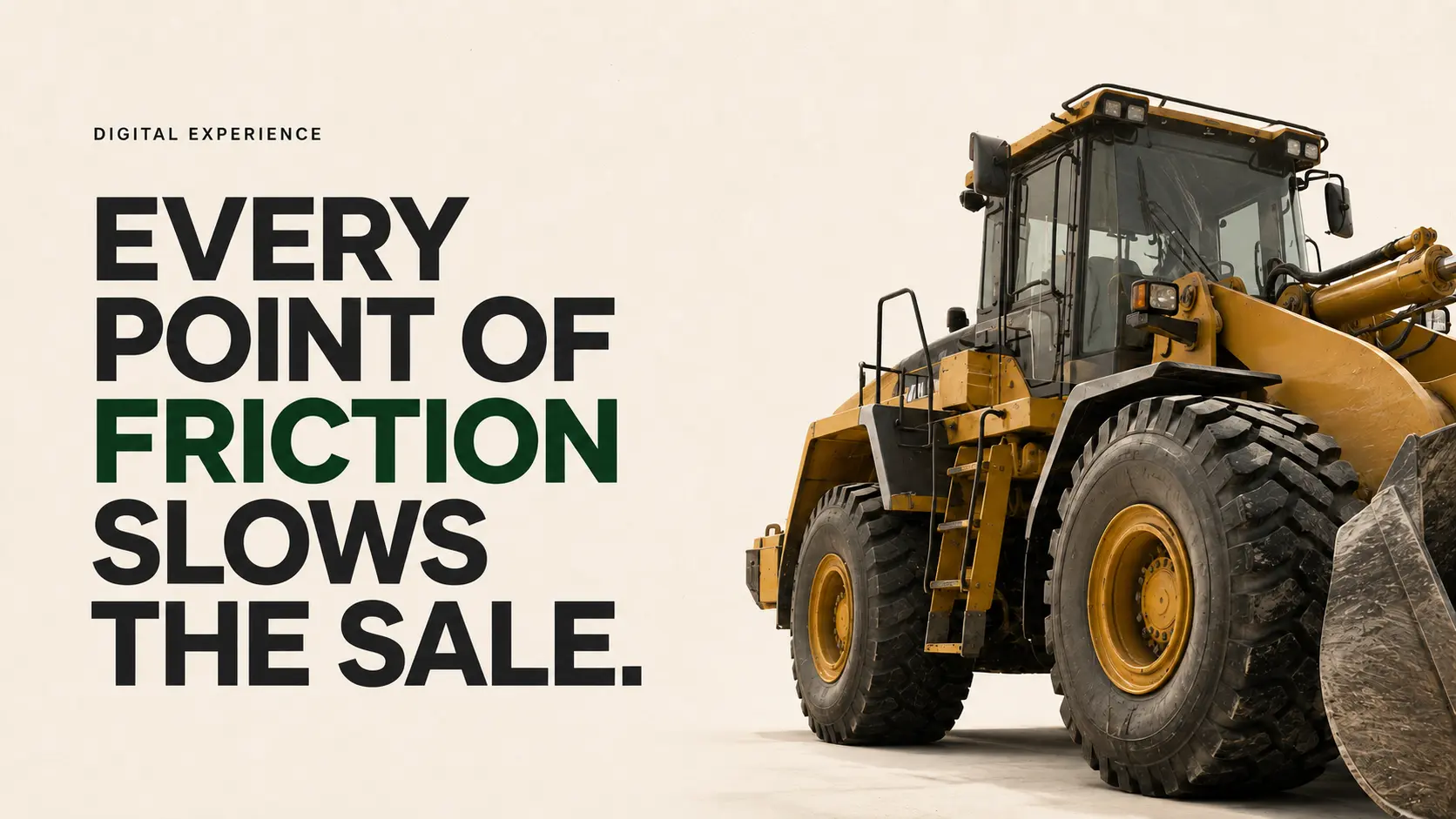
Every point of friction slows the sale. Every clear answer builds momentum.

About Flywheel Strategic
Flywheel Strategic is an award-winning agency that turns digital and operational challenges into clear, workable solutions built around meaningful business outcomes. Founded more than 20 years ago, Flywheel brings deep expertise across automation, digital experience, design, strategy, and capability augmentation. The team helps organizations modernize legacy systems, connect fragmented data, and create more reliable, accessible digital experiences for customers, dealers, employees, and partners.