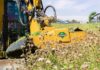

New 720H, 724H and 726H feller bunchers feature a longer wheelbase, redesigned cab, improved visibility and expanded hydraulic options
Tigercat has launched a new trio of next gen H-series feller bunchers equipped with major upgrades.
The next generation drive-to-tree feller bunchers includes the 720H, 724H and 726H. The wheelbase of all three machines has been increased by 115 mm and the physical size of the 720H and 724H remains identical.
By increasing the wheelbase, and a built-in 410-kg rear bumper, Tigercat improved handling and stability while decreasing the turn radius to increased agility in tight stands.
When equipped with the Tigercat FPT N67 Tier 4 Final engine, the 720H is rated at 203 hp, the 724H is rated at 246 hp, and the 726H is rated at 285 hp.
The common operator’s cab has been completely redesigned and includes increased interior volume for more legroom, additional storage and a roomier feel.
RELATED: Tigercat attachments transition to the TCi brand
Tigercat also improved operator sightlines with a front windshield that is 27 per cent larger and rear quarter windows that are 40 per cent larger. Visibility is also enhanced by the dual camera rearVIEW system. For upward visibility, the skylight is 40 per cent larger and installed directly on a 20 mm forward sloping roof plate to easily shed debris. As well, the operator can easily access the outside of the front window area for cleaning.
Simplified joysticks with programmable buttons allow the operator to customize controls for the clamp and accumulator arms, saw, differential locks and drive functions. The roof-mounted A/C system, common with the 600H series skidders, improves cooling performance and comfort.
Another major change for the H-series feller bunchers is a new hydraulic system option. Loggers now have the choice of the tried-and-true gear pump system, or the new piston pump load sense system for improved multifunctioning. Both system choices maintain the use of pilot operated joysticks for boom and steer control.
New in-tank hydraulic filtration extends service intervals up to 2,000 hours.
Maintenance and service improvements include a larger engine air filter, a more conveniently located manual fuel fill port, an optional ground level fuelling system and improved access to the hydraulic pumps and electrical systems.
X877 buncher
Tigercat’s first production X877 feller buncher is also now at work in central Canada.
The new X877 track feller buncher is the next model built on the sloped-tail platform to roll off the assembly line and onto a Canadian logging operation.
The X877 is a high-performance carrier with a closed loop drive system. As a result, the machine has excellent multifunction characteristics, which is ideal for highly skilled and experienced operators looking to boost productivity.
The sloped-tail platform delivers tail clearance when swinging over obstacles, while retaining clear and convenient access to daily service points and machine components. With a fully retracting roof enclosure, both sides of the engine, valves and hydraulic pump area are exposed and easy to reach. The upper assembly is designed to house both the Tigercat FPT N67 and C87 engines for improved commonality.
The long track frames and an integrated counterweight ensure machine balance and stability. As well, a newly designed ER boom system offers tighter tuck and a larger boom envelope. ER technology, developed exclusively by Tigercat Industries, reduces operator fatigue and conserves energy.
The operator’s cab is equipped with a comfortable parallel action suspension seat with integrated heating and cooling, and full adjustability. Clear sightlines and ergonomic positioning of controls reduce operator fatigue over long shifts.
850 processor
Tigercat’s 850 processor, its purpose-built alternative to excavator conversions, has also been upgraded for improved performance.
The performance and fuel efficiency differential has been further increased. Initial field testing confirms that the 14 per cent increase in power to 251 hp results in improved machine performance and response — quicker, smoother boom cycles, improved feed acceleration and braking, as well as a more powerful swing. In addition, hydraulic system refinements target boom efficiency, reducing fuel consumption.